
Turning a passion for outdoor work into a thriving, profitable landscaping enterprise offers a direct path to financial independence, creative fulfillment, and remarkable business scalability. The green industry represents a multi-billion-dollar market driven by steady residential lawn maintenance needs, commercial facility management contracts, and high-ticket residential outdoor living transformations.
However, building a sustainable landscaping business requires far more than purchasing a commercial lawnmower and placing an advertisement online. Long-term success demands a disciplined operational approach: establishing legal protections, managing heavy equipment assets, optimizing fuel logistics, mastering hardscape installation, and executing year-round revenue strategies.
Whether you start as a solo operator working out of a single pickup truck or aim to scale a multi-crew fleet, this comprehensive guide provides a step-by-step operational blueprint. You will learn how to navigate legal compliance, source commercial materials, expand into high-margin hardscaping, maintain year-round revenue, and execute local marketing strategies to build a lasting, profitable enterprise.
Establishing Business Foundations, Licensing, and Legal Protections

Before taking on your first paying client or starting up a piece of heavy equipment, you must establish a compliant legal foundation. Operating without proper corporate structuring, commercial liability insurance, and written service agreements leaves your personal assets vulnerable to lawsuits, property damage claims, and regulatory fines.
First, select a formal business entity structure. While operating as a sole proprietorship is fast and inexpensive, forming a Limited Liability Company (LLC) or S-Corporation creates a crucial legal boundary between your personal finances and business liabilities. Consult with experienced accounting professionals and specialized business attorneys to draft your foundational corporate documents, register your operating name, and set up tax accounts. Attorneys who understand local commercial trade regulations can also draft customized client service contracts, subcontractor agreements, and liability waivers that protect your business if underground utilities or unmarked irrigation lines are damaged during excavation.
Second, secure precise property boundary documentation before beginning any major earthmoving, excavation, or perimeter hardscape project. Relying on informal fence lines or visual estimates can result in costly property line disputes with neighboring landowners. Hiring a licensed land surveyor during the initial design phase ensures that retaining walls, drainage systems, outdoor kitchens, and perimeter plantings are installed strictly within your client’s legal property boundaries, avoiding disastrous teardown demands later.
Third, obtain mandatory commercial insurance coverage. A comprehensive business insurance policy should include General Liability coverage to protect against accidental property damage, Commercial Auto insurance for your truck and trailer fleet, and Workers’ Compensation coverage to protect your employees in the event of job site injuries.
- Choose the right legal entity: Register your business as an LLC or S-Corporation to protect personal savings, home equity, and personal vehicles from business liabilities.
- Draft bulletproof client contracts: Work with legal professionals to establish clear payment terms, weather delay clauses, scope-of-work limits, and cancellation policies.
Equipment Acquisition, Material Sourcing, and Fuel Logistics

Your equipment choices and material supply networks dictate your operational speed, job quality, and profit margins. Equipping a landscaping startup requires balancing initial capital outlays with long-term mechanical reliability. Over-investing in top-tier new machinery can drain early cash reserves, while relying on worn-out equipment leads to frequent breakdowns, missed client schedules, and lost revenue.
When launching your service line, focus on acquiring core commercial-grade machinery rather than consumer-grade tools. Commercial zero-turn mowers, heavy-duty string trimmers, backpack leaf blowers, and tandem-axle utility trailers are engineered for continuous daily use. Consumer equipment quickly breaks down under heavy commercial workloads, leading to excessive downtime. Purchase quality pre-owned commercial equipment or lease major assets during your first year to preserve operating cash.
Establishing strong trade vendor relationships is equally vital for material profitability. Build direct trade accounts with local masonry supply yards, wholesale plant nurseries, and bulk mulch distributors. Establishing commercial trade accounts gives you access to volume contractor discounts on concrete pavers, natural stone, wall blocks, gravel, and topsoil, allowing you to markup raw materials for clients while remaining competitively priced.
Additionally, optimize your fleet fuel management strategies to control daily operating overhead. Running a commercial mowing and installation fleet requires significant fuel inputs. For large commercial mower fleets, consider sourcing agricultural propane as an alternative fuel solution. Propane-powered commercial mowers reduce per-gallon fuel expenses, eliminate carburetor gumming caused by ethanol-blended gasoline, prevent fuel theft, and allow you to bid on green municipal contracts that mandate reduced carbon emissions.
- Invest in commercial-grade equipment: Prioritize commercial zero-turn mowers and heavy-duty handheld tools built to withstand eight hours of daily runtime.
- Set up wholesale vendor accounts: Establish trade relationships with local material yards to lock in contractor discounts on stone, soil, and nursery stock.
Designing High-Margin Hardscaping and Outdoor Construction Services
While routine lawn maintenance and weed control provide steady, recurring baseline cash flow, expanding into hardscaping and outdoor living construction generates high profit margins and substantial ticket prices per project. Homeowners continue to view their outdoor spaces as primary living and entertainment environments, creating strong demand for custom patios, retaining walls, and functional stone features.
Designing and installing custom outdoor features—such as paver patios, retaining walls, fire pits, and stone walkways—allows you to command premium labor rates. Success in hardscaping relies heavily on rigorous site preparation. Improper excavation depth, inadequate aggregate base compaction, or poor slope planning will inevitably lead to shifting stones, pooled water, and failing retaining walls. Invest in professional compaction equipment, laser levels, and diamond-blade masonry saws to execute flawless installations.
Cross-industry networking can also accelerate your project pipeline. Build professional referral relationships with complementary home service companies, such as local roofing businesses, general contractors, and pool builders. Roofers frequently replace gutter downspout systems and notice grading or water runoff problems around home foundations; partnering with them creates a steady stream of client referrals for custom French drains, stone splash pads, and grading services.
Furthermore, utilize modern digital design tools during client sales presentations. Using 3D landscape design software allows homeowners to visualize their completed outdoor kitchens, retaining walls, and paver patios before construction begins, speeding up contract approvals and making upsells easier.
- Master proper sub-base preparation: Excavate down to undisturbed subsoil and install compacted gravel bases to prevent stone settling and shifting over time.
- Invest in specialized masonry tools: Outfit your crew with wet-cut masonry saws, plate compactors, laser levels, and heavy-duty paver clamps.
Expanding Into Heavy Cleanup and Surface Restoration
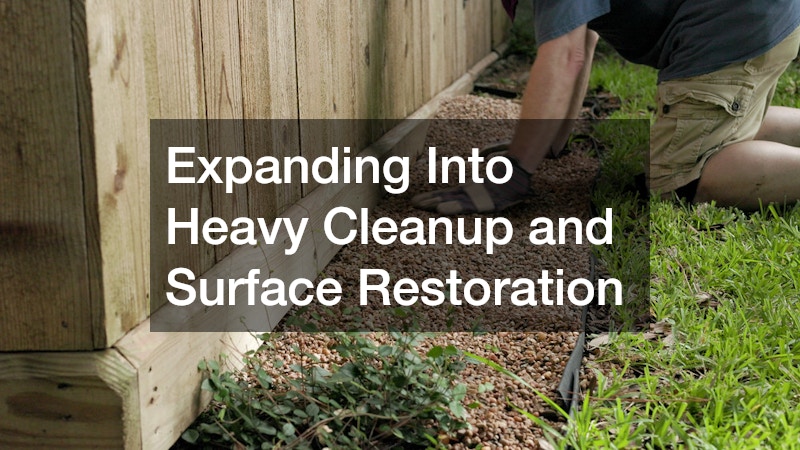
To stand out in a crowded market, offer specialized property cleanup, land clearing, and surface restoration services. These specialty offerings often carry minimal material overhead, allowing you to command high hourly billing rates while providing valuable solutions to property owners dealing with neglected grounds or storm damage.
Integrating heavy seasonal property cleanouts into your service catalog captures lucrative spring and fall revenue. Offer comprehensive lot clearing, overgrown brush removal, and fallen timber processing. To execute these heavy cleanups efficiently without cluttering your main equipment yard, coordinate with local bulk pickup services or commercial waste haulers to deliver roll-off dumpsters directly to the job site. Efficient waste removal keeps the site safe and speeds up work.
Another high-margin service line is specialized masonry and architectural surface restoration. Over time, stone patios, retaining walls, brick walkways, and metal gates accumulate layers of dirt, efflorescence, moss, rust, and flaking paint. Acquiring mobile industrial sandblasting systems or high-pressure soda-blasting rigs allows your crew to restore weathered masonry, clean concrete, and strip paint from iron fencing without damaging the underlying surface.
Offering surface restoration alongside your core hardscaping services allows you to upsell existing clients on patio restoration, stone sealing, and hardscape rejuvenation, breathing new life into old outdoor features at a fraction of full replacement costs.
- Offer comprehensive seasonal cleanups: Package spring bed clearing, fall leaf removal, and brush clearing into high-value seasonal service bundles.
- Partner with waste management haulers: Coordinate on-site dumpster deliveries for heavy debris and brush clearing projects to maintain clean job sites.
Drainage Solutions, Winter Services, and Year-Round Revenue
One of the greatest operational hurdles for landscaping businesses in seasonal climates is managing the winter income drop. Relying solely on warm-weather lawn care creates severe financial stress during cold months. To build a resilient business, offer services that generate year-round revenue.
First, develop specialized site drainage and water management capabilities. Heavy rain, melting snow, and improper property grading cause severe water pooling, soil erosion, and foundation dampness. Designing and installing French drains, catch basins, dry creek beds, and swales positions your business alongside indoor water damage remediation companies. While remediation specialists repair indoor water damage after a flood, your landscaping crew resolves the exterior grading and surface drainage problems that caused the water intrusion in the first place.
Second, pivot your summer lawn maintenance crews into winter service operations. Offering commercial snow plowing, sidewalk salting, and ice management to shopping centers, office parks, and HOA communities keeps your equipment active and your core staff employed year-round.
Pre-sell winter service contracts during late summer and early autumn. Structure your snow contracts using seasonal retainers—where commercial clients pay a fixed monthly fee regardless of total snowfall—or per-push billing models to ensure predictable winter cash flow.
- Offer complete exterior drainage installation: Build French drains, swales, and catch basins to redirect stormwater away from home foundations.
- Cross-refer with indoor restoration firms: Build relationships with water mitigation specialists who can refer clients needing exterior site re-grading.
Marketing, Branding, and Scaling Customer Acquisition

A well-equipped landscaping company cannot survive without a steady stream of qualified customer leads. Building a strong local brand, establishing an active online presence, and executing targeted offline marketing campaigns converts casual inquiries into lucrative, long-term service agreements.
Investing in professional physical branding yields immediate local visibility. Partner with a professional Business Printing Service to produce high-quality door hangers, lawn signs, vehicle magnetic signs, and high-visibility fleet truck wraps. Outfitting your service vehicles with bold graphics turns every job site into a local billboard, generating immediate inquiries from nearby neighbors who see your crew at work.
Concurrently, build a strong local digital marketing system. Claim and optimize your Google Business Profile, ensuring your business category, service areas, phone number, and website link are accurate. Encourage satisfied clients to leave detailed online reviews, and upload high-resolution before-and-after photographs of completed hardscape installations, drainage projects, and lawn transformations. Local search engine optimization (SEO) ensures your company appears at the top of search results when local homeowners search for landscaping services in their area.
Finally, implement route density strategies to maximize daily field efficiency. windshield time, the unpaid hours your crew spends driving between distant jobs, is a silent profit killer. Offer group neighborhood discounts to adjacent homeowners on streets where you already serve clients. Clustering five lawn maintenance accounts on the same block reduces fuel burn, minimizes vehicle wear, and dramatically increases daily labor profitability.
- Wrap your vehicle fleet: Turn trucks, trailers, and equipment boxes into mobile billboards with high-visibility logo wraps and clear contact information.
- Utilize targeted print marketing: Distribute custom door hangers and direct-mail postcards to homes within a two-block radius of active hardscape job sites.
Strategic Blueprint for Sustainable Business Growth
Scaling your landscaping startup from a single truck operation into a multi-crew enterprise requires shifting from relying strictly on manual labor to managing business systems, workforce logistics, and financial health.
As your active client roster grows, transition away from manual paper scheduling by adopting field service management software. Modern digital platforms streamline client quoting, job dispatching, route optimization, time tracking, and automated credit card invoicing. Streamlining administrative tasks frees up your time to focus on quality control, employee retention, client relations, and commercial sales growth.
Focus heavily on workforce training and safety culture. The landscaping industry experiences high turnover, but offering competitive hourly wages, safe equipment, performance bonuses, and career growth pathways helps retain quality crew leaders. Investing in your team builds a reliable workforce that delivers exceptional craftsmanship on every job site.
By establishing sound business foundations, acquiring quality tools, expanding into high-margin trades, maintaining year-round service offerings, and executing route-dense marketing, you build a resilient, highly profitable business. Physical labor, when combined with business discipline and strategic execution, provides an unbeatable path to lasting career independence and financial success.